

ReptilianThe Cold-Blooded
The Reptilian is a folkloric and fictional figure: a tall, scaled humanoid that appears in serpent myths worldwide, in pulp science fiction, and in late-20th-century conspiracy theories. XenoAtlas records it as a cultural archetype. Claims of a hidden reptilian elite are unsupported and have been widely criticised for their use in antisemitic conspiracy narratives.
At a glance
- Home system
- Alpha Draconis (lore)
- Avg. height
- 6′3″ – 8′10″
- Appearance
- Scaled skin, vertical pupils, muscular build
- Reported lifespan
- Unknown
- Social structure
- Described as strictly hierarchical
- Technology
- Described as advanced and militarised
- Primary traits
- Described as dominant, strategic, secretive
- Relationship to Earth
- Conspiracy folklore claims hidden influence; no evidence
Physical profile
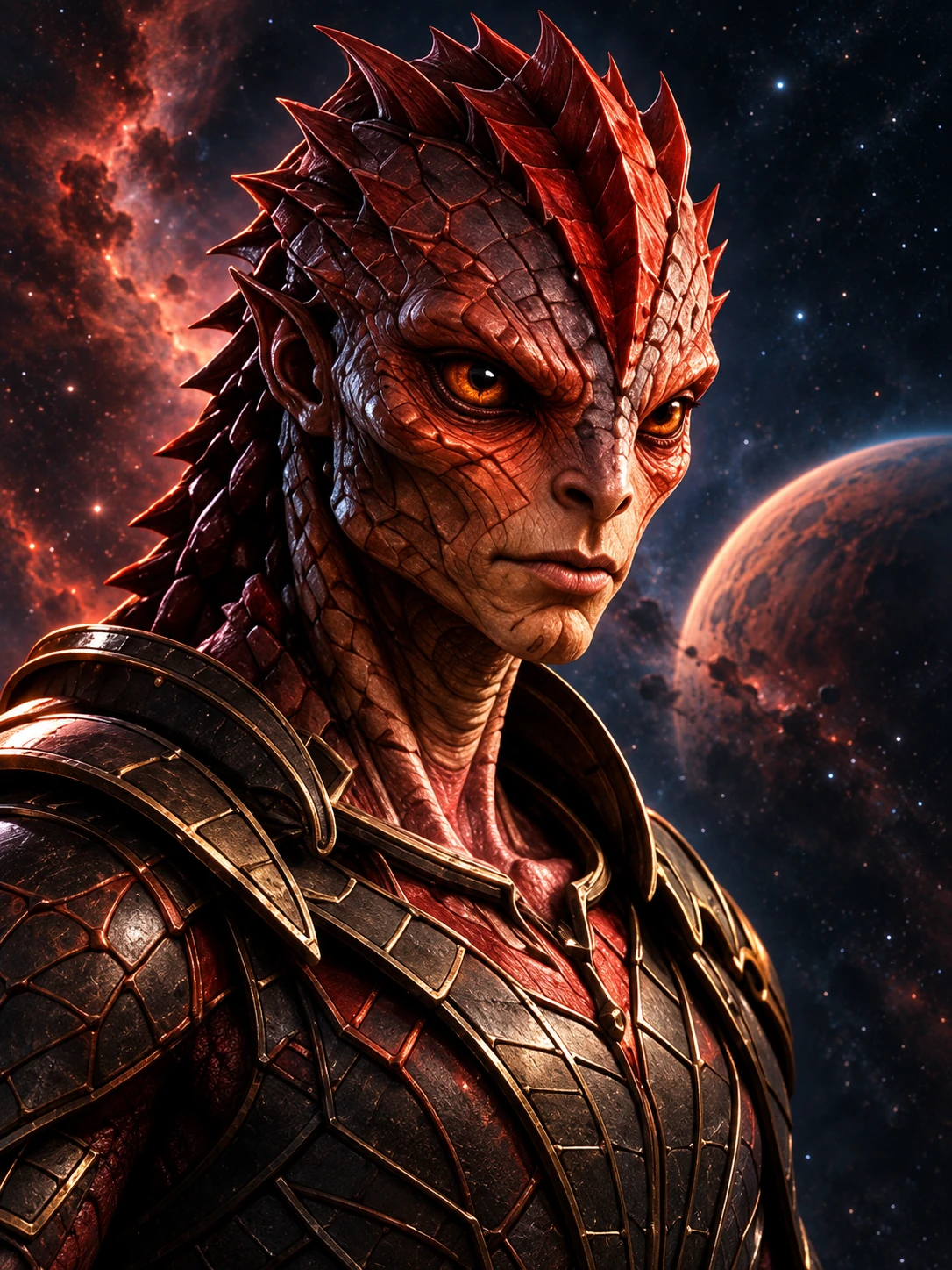
Descriptions of the Reptilian are consistent across fiction and conspiracy literature because the second borrowed heavily from the first. The being stands between six and nine feet tall, heavily muscled, with green, brown, bronze or grey scales, a ridged skull or crest, and a face somewhere between human and lizard: a flattened nose, a wide mouth, and eyes with vertical slit pupils in gold or yellow. Hands are clawed, usually with four digits. Some versions have a tail, dorsal spines or a frill.
The type is almost always described as physically dominant, and that is the point of it. Where the Grey is uncanny and the Nordic is idealised, the Reptilian is a predator. Its body language in every telling is upright, still and menacing. Clothing varies from nothing to elaborate armour, and in conspiracy writing the being is often said to wear a human disguise, either a hologram or a physical shape-shift, which is the mechanism by which it supposedly hides among us.
Reported origin
Lore places the Reptilian homeworld in Draco, the long northern constellation that winds between the Bears, and specifically near Thuban, the star that served as Earth's pole star around 2700 BCE. The choice is symbolic: Draco means dragon, and Thuban's ancient role connects the type to the pyramid-building era that ancient-astronaut writers favour. There is no astronomical basis for it; Thuban is a white giant with no known planets.
An alternative tradition makes Reptilians native to Earth, descended from dinosaurs and driven underground, an idea that owes more to pulp science fiction than to any witness account. Both versions serve the same narrative purpose: they give the being a claim on this planet that predates humanity.
Culture
Reptilian society, in every source, is a hierarchy. Fiction gives it castes, dynasties and warrior codes. Conspiracy writing gives it a secret aristocracy that manipulates human institutions. The consistent themes are dominance, secrecy and long-term strategy, with the beings portrayed as patient to the point of operating across centuries. Emotion is described as either absent or limited to contempt and appetite.
Technology
Fictional and conspiracy sources describe cloaking, holographic disguise, shape-shifting, mind control and large armoured vessels. None of this appears in sighting reports in any consistent way, because the Reptilian is barely present in sighting reports at all. Its technology is narrative technology, invented to explain how a species could rule the world unseen.
Craft
Where craft are described they are large, dark and angular: triangles, wedges and motherships rather than the bright discs of the contactee era. Some writers associate Reptilians with the black triangle sightings of the 1980s and 1990s, though those reports rarely include occupants of any kind.
Communication
Fiction gives Reptilians a hissing spoken language and, frequently, telepathic domination. Conspiracy literature emphasises manipulation through human proxies rather than direct contact. Genuine first-hand encounter reports involving reptilian beings are rare and mostly date from after the type was already established in popular culture.
Earth encounters
Serpent-people are ancient. The Nāga of Indian tradition, the feathered serpent Quetzalcoatl, the Chinese dragon kings and the serpent in Genesis all give the form a religious pedigree. The modern reptilian humanoid, though, is a twentieth-century creation. Robert E. Howard's 1929 story 'The Shadow Kingdom' introduced serpent-men who disguise themselves as humans and infiltrate a royal court, and that plot has never really changed.
The conspiracy version was popularised by the British writer David Icke from the early 1990s, who claimed that a reptilian bloodline controls world governments. The claim is unsupported by evidence and has been widely criticised for reproducing the structure of older antisemitic conspiracy theories about hidden elites. XenoAtlas includes the Reptilian because it is a major cultural archetype, and notes that criticism plainly.
A handful of first-hand accounts do exist. In 1967 a witness near Ashland, Nebraska, a police officer named Herbert Schirmer, described under hypnosis being taken aboard a craft by beings with slightly reptilian features. In the 1980s a few abduction narratives collected by researchers included scaled or lizard-like beings, usually in a menacing role. These reports are rare, post-date the fiction that describes the same creature, and are dwarfed by the volume of Grey accounts.
Lore & history
In the folkloric reading, the Reptilian is the dragon and the serpent given a spaceship. Its function is the same as theirs: to embody a hidden, cold, powerful threat. That is why the type thrives in fiction, where it is a superb villain, and why it should be handled carefully outside fiction, where the same story has been used to accuse real groups of people.
The type's most consequential real-world life is in the conspiracy theory. David Icke's The Biggest Secret (1999) claimed that a reptilian bloodline includes royalty, presidents and financiers. Scholars of conspiracy culture, including Michael Barkun, have documented how the reptilian narrative reproduces the structure of older antisemitic myths about a hidden, blood-linked elite manipulating world events, whether or not individual believers intend that reading. Surveys have found a small but measurable share of the public willing to say reptilians might exist, which is why the archive states the evidential position plainly.
Encounters on record
Source notes
- Reptilian conspiracy theory — origins and criticism · encyclopedic summary
- David Icke, The Biggest Secret (1999) · conspiracy literature, primary sourceFind on Amazon
- Michael Barkun, A Culture of Conspiracy (2003) · critical studyFind on Amazon
Book links go to Amazon. As an Amazon Associate, XenoAtlas earns from qualifying purchases at no extra cost to you.
XenoAtlas documents extraterrestrial concepts appearing in mythology, contactee literature, popular culture, speculative accounts, and related sources. Inclusion does not constitute scientific verification.
Side by side
Related species

See every type in the Types of Aliens guide.