

The Roswell Incident
A rancher found strange debris; the Army announced it had recovered a 'flying disc', then said it was a weather balloon. Decades later the story acquired crashed craft, bodies and a cover-up. The debris was a classified balloon project; the bodies came later.
- Date
- July 1947
- Place
- Foster ranch, near Roswell, New Mexico, USA
- Witnesses
- W. W. 'Mac' Brazel, Major Jesse Marcel and later claimants
- Status
- Conventionally explained
What happened
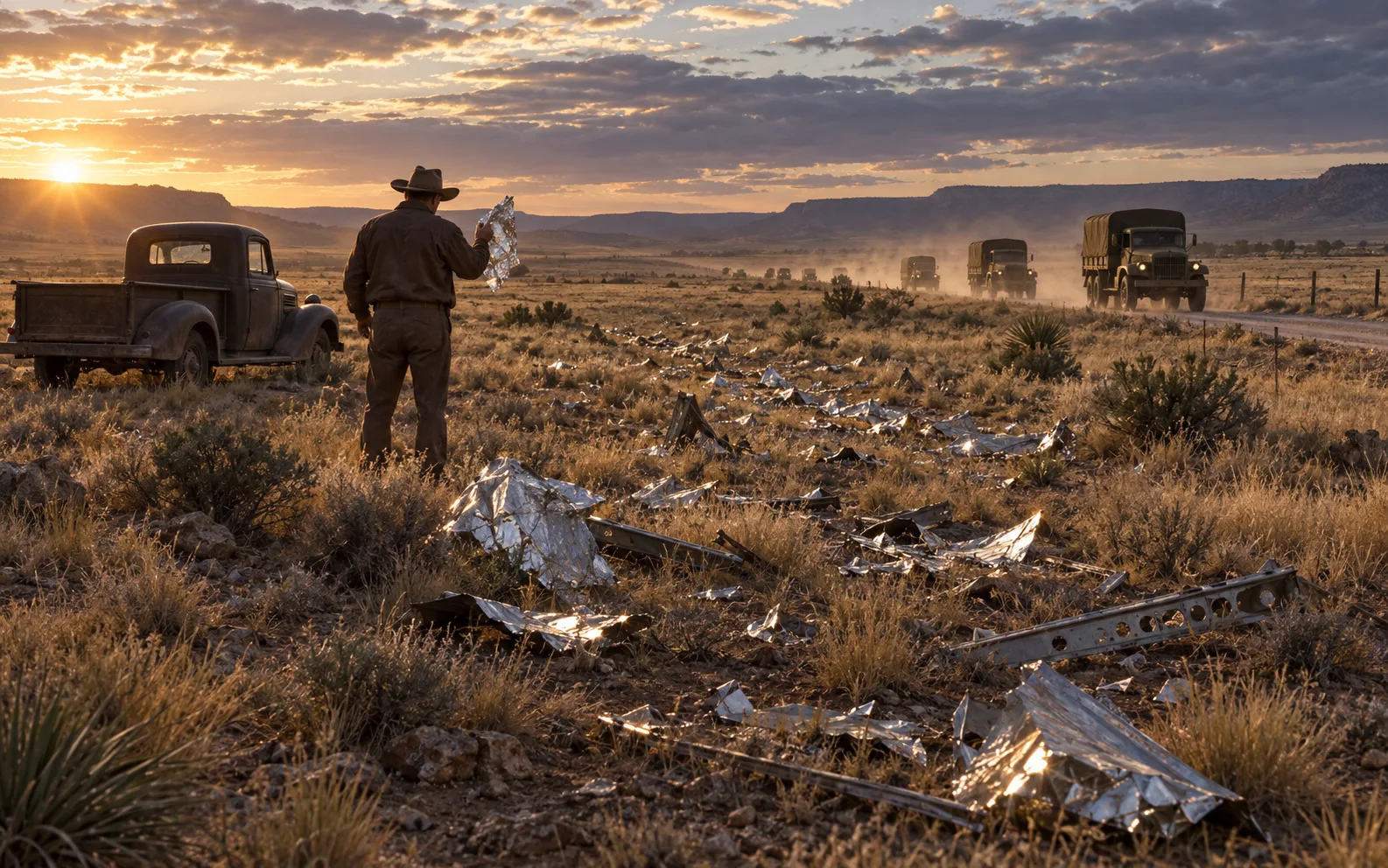
In June or early July 1947, ranch foreman Mac Brazel found a large area of scattered debris, foil, rubber, tape and sticks, on the Foster ranch. After the first flying-saucer reports made national news that month, he took some to the sheriff, who called Roswell Army Air Field. On 8 July the base issued a press release saying it had recovered a 'flying disc'; the same day General Roger Ramey in Fort Worth displayed weather-balloon material and the story was withdrawn. It was forgotten for thirty years.
In 1978 the ufologist Stanton Friedman interviewed Jesse Marcel, the intelligence officer who had collected the debris, who said the material was not a balloon. The 1980 book The Roswell Incident assembled the modern legend, and through the 1980s and 1990s new witnesses added a second crash site, alien bodies, a military cover-up and, in 1995, a widely broadcast 'alien autopsy' film that its producer later admitted was staged.
The beings
The bodies are entirely a product of the later accounts: small, grey, large-headed beings, sometimes described as four feet tall with four fingers, laid out in a hangar or seen by a nurse. None of these witnesses was in a position to have seen anything in 1947 that was not a balloon, and several accounts have been shown to be fabricated. The Roswell alien is the Grey, retrofitted.
Aftermath
In 1994 and 1997 the US Air Force published reports identifying the debris as part of Project Mogul, a classified programme that flew trains of balloons with radar reflectors to listen for Soviet nuclear tests, and attributing the 'bodies' to memories of crash-test dummies dropped in the 1950s. Roswell has a museum and a festival, and the name means UFO in every language.
Explanations
The Mogul explanation fits the debris described in 1947 in detail, including the tape with flower-like patterns that a toy company had supplied. The legend's growth is well documented by researchers on all sides, and the case is the clearest example of how a small event can be rebuilt into a myth by decades of retelling. XenoAtlas includes it for that reason.
Beings described

Sources
Book links go to Amazon. As an Amazon Associate, XenoAtlas earns from qualifying purchases at no extra cost to you. Every book the Atlas cites is shelved in the Reading Room.